How to Start a Water Refill Station Business in Kenya
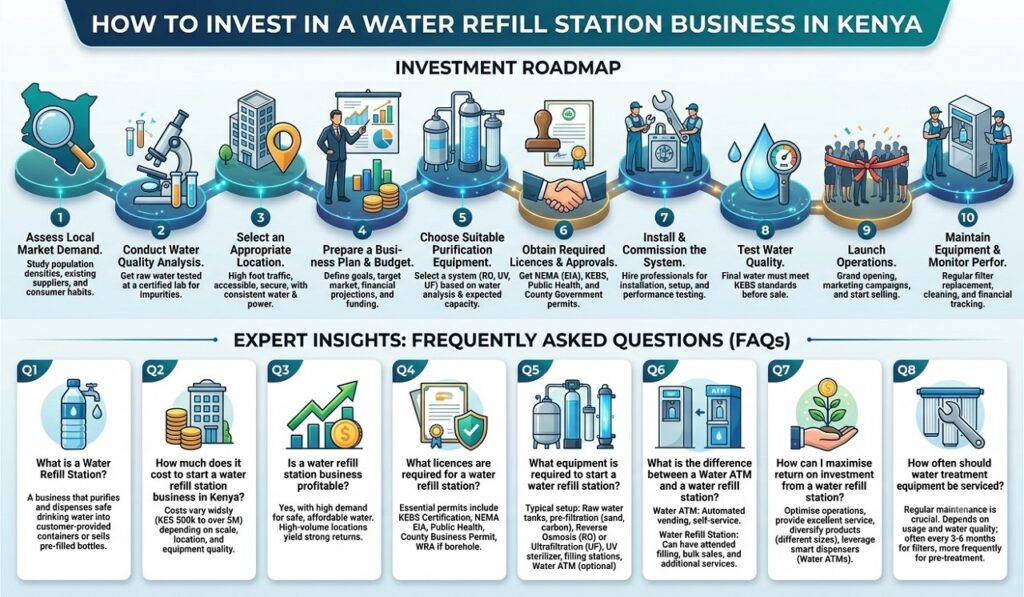
How to Start a Water Refill Station Business in Kenya A water refill station business in Kenya involves purifying water from a borehole, spring or municipal source and selling it to customers who bring their own containers. Setup costs typically range from KES 100,000 to KES 800,000 depending on scale, and operators commonly report gross margins of 40 to 60 percent once licensing, equipment and location are in place. Kenya’s water refilling sector has grown into one of the country’s most accessible small business opportunities. Unreliable municipal supply, rising health awareness and steady urban population growth have combined to create consistent demand for affordable, safe drinking water. For entrepreneurs weighing where to place their capital, a refill station offers low technical complexity, a non-perishable product and a relatively short payback period. This guide on how to start a water refill station business in Kenya walks through what a water refill station actually is, whether it is profitable, and the ten practical steps involved in setting one up in Kenya, including the licences you will need from the Kenya Bureau of Standards (KEBS), the National Environment Management Authority (NEMA) and your county government. What Is a Water Refill Station? A water refill station is a commercial facility that treats raw water and dispenses it to customers who supply their own containers, typically 20-litre jerry cans, 10-litre bottles or 5-litre bottles. The term covers the entire setup, including storage tanks, the purification system and the dispensing point, whether that dispensing point is staffed or automated. Water refill station versus water ATM The two terms are often used interchangeably in the Kenyan market, but there is a practical distinction worth understanding before you buy equipment. Feature Water Refilling Station Water ATM Operation Usually attended by staff who dispense water manually Self-service, coin, token or M-Pesa operated Typical setting Shops, kiosks, small retail premises Estates, corridors, apartment blocks, schools Automation Basic to moderate High, often with digital monitoring Entry cost Generally lower for a single-tap manual unit Similar or slightly higher once payment hardware is added Staffing Usually requires an attendant Can run largely unattended In practice, most commercial units sold in Kenya today combine both functions, offering manual taps alongside coin or mobile-money payment options. Is a Water Refill Station Business Profitable in Kenya? Yes, water refilling is generally considered a profitable small business in Kenya, though actual returns depend heavily on location, pricing and operating discipline. Industry suppliers commonly cite gross margins in the range of 40 to 60 percent, with some estimates for well-run stations reaching higher, largely because the cost of purifying and dispensing water is low relative to the retail price. A simple way to think about the unit economics: if a 20-litre jerry can costs roughly KES 60 to produce (electricity, water, filter wear and consumables) and sells for KES 100, that is a gross profit of around KES 40 per can. At 25 to 50 refills a day, that translates into daily gross profit of KES 1,000 to KES 2,000 before rent, wages and licensing amortisation. Several factors point to sustained demand: Unreliable municipal supply. Many Kenyan towns experience intermittent piped water, pushing households and small businesses towards refill stations as a dependable alternative. Growing population. Kenya’s urban population continues to expand, particularly around Nairobi, Mombasa and Kisumu, increasing the customer base within walking distance of a well-placed station. Lower cost than bottled water. Refilled water is typically priced well below sealed bottled water, making it attractive to price-sensitive households. Low inventory risk. Water does not spoil in the way food products do, which reduces waste-related losses common in other small retail ventures. We would caution against treating any single profit figure as guaranteed. Margins vary by county, competition density and how disciplined the operator is about maintenance and pricing. Underpricing to compete on volume, without controlling electricity and filter replacement costs, is a common reason stations underperform. How to Start a Water Refill Station Business in Kenya: 10 Steps Step 1. Assess Local Market Demand Start by mapping water access in your target area. Look for estates, schools, markets and offices within walking distance that currently rely on unreliable municipal supply, expensive bottled water or distant refill points. Count existing competitors and note their pricing, queue lengths and container sizes served, since this tells you both the size of the opportunity and how saturated the market already is. Step 2. Conduct Water Quality Analysis Before committing to equipment, test your intended water source, whether borehole, spring or municipal connection, at an accredited laboratory. This establishes baseline levels of turbidity, total dissolved solids (TDS), pH, fluoride, heavy metals and microbiological contamination such as E. coli and total coliforms. The results determine which purification stages your system actually needs. A borehole with high fluoride or salinity, for instance, will need a different reverse osmosis configuration than a relatively clean municipal supply that mainly needs filtration and disinfection. Step 3. Select an Appropriate Location Location decisions should weigh foot traffic, visibility, accessibility for customers carrying containers, and proximity to reliable electricity. High-density residential estates, areas near schools and markets, and busy pedestrian routes tend to perform best. Confirm that the premises is not located within a residential setup with living quarters above the business floor, since KEBS will not certify a bottling or refilling operation in that configuration. Step 4. Prepare a Business Plan and Budget A basic business plan should cover your target market, pricing strategy, equipment and setup costs, licensing budget, and a simple monthly cash flow projection. Startup costs for a small manual refilling station typically fall between KES 100,000 and KES 300,000, while mid-sized setups with automated dispensing and higher throughput can run to KES 800,000 or more. Build in licensing fees, initial water testing, rent deposits and a buffer for the first two to three months of operating costs before the business becomes self-sustaining. Step 5. Choose Suitable Purification Equipment Most Kenyan refill stations combine sediment filtration, activated carbon filtration, reverse osmosis (RO)